Serving Wisconsin
Northern Illinois &
Eastern Iowa

Author name: admin

Uncategorized

Can Dogs Find Bed Bugs?

Can Dogs Find Bed Bugs? If you’ve ever dealt with bed bugs, you know how stressful and frustrating they can be. These tiny pests—most commonly Cimex lectularius—are experts at hiding. They tuck themselves into mattress seams, bed frames, baseboards, and even behind electrical outlets. By the time you notice bites or small rust-colored stains on your sheets, the infestation may already be well established. Because bed bugs are so difficult to spot with the naked eye, many people wonder whether dogs can actually help find them. The short answer is yes. With proper training, dogs can detect live bed bugs and viable eggs using their sense of smell. In fact, canine scent detection has become an increasingly popular tool in pest management over the past two decades. But how does it really work? And how reliable is it? Let’s take a closer look. Signs Your Dog Can Find Bed Bugs When a trained detection dog locates bed bugs, the behavior is usually clear and deliberate. These dogs are not simply wandering around sniffing randomly—they are working. Some of the most common signs include: Most bed bug detection dogs are trained to give a passive alert, such as sitting or lying down. This prevents damage to furniture and keeps the inspection professional and controlled. If you see a dog calmly sit beside a bed frame after carefully sniffing it, that’s often a trained alert behavior. Body Language During Bed Bug Detection Dogs communicate constantly through body language, and during detection work, even small changes matter. Here are some behaviors handlers watch closely: To an untrained eye, these cues may seem subtle. That’s why handler experience is just as important as the dog’s training. A good handler knows the difference between casual curiosity and a genuine alert. The History of Dogs in Bed Bug Detection Bed bugs were once largely under control in many parts of the world. After World War II, widespread pesticide use significantly reduced infestations. However, in the late 1990s and early 2000s, cases began rising again due to pesticide resistance and increased international travel. As infestations spread, pest control professionals needed faster and more accurate ways to locate hidden bugs. Since dogs had already proven effective in narcotics, explosives, and search-and-rescue work, adapting them for bed bug detection was a natural step. Organizations such as the National Entomology Scent Detection Canine Association began developing certification standards, while research institutions like the University of Florida studied detection accuracy under controlled conditions. Over time, canine inspections became a recognized part of integrated pest management. The Science Behind Dogs Detecting Bed Bugs A dog’s nose is truly remarkable. While humans have around 5 to 6 million scent receptors, dogs can have up to 300 million, depending on the breed. Their brains are also specially wired to process scent information far more efficiently than ours. Live bed bugs and viable eggs release tiny amounts of volatile organic compounds (VOCs). Trained dogs learn to recognize this specific odor profile and ignore unrelated smells in the environment. Common breeds used in scent detection work include: Research shows that under controlled conditions, well-trained dogs can reach detection rates above 90 percent. However, real-world performance varies. Environmental distractions, handler influence, and inconsistent training can affect results. Training a Dog to Detect Bed Bugs Training a bed bug detection dog is not something that happens overnight. It requires structured, consistent work. The process typically includes: Certification programs, including those offered by the National Entomology Scent Detection Canine Association, help ensure professional standards are met. Equally important is handler education—because even the best dog can give unreliable results without proper guidance. Safety Tips for Bed Bug Detection Dogs Detection dogs are working animals, and their health and safety must come first. Important safety considerations include: A healthy, focused dog performs better and provides more reliable results. Tips & Things to Know Frequently Asked Questions (FAQs) How do bed bug detection dogs locate bed bugs? They identify the specific odor released by live bed bugs and viable eggs, even when hidden behind walls or inside furniture. What behaviors show a dog has found them? Focused sniffing, posture changes, and a trained passive alert—usually sitting—are common indicators. How reliable are detection dogs? In controlled environments, detection rates can exceed 90 percent. In real-life situations, reliability varies depending on training and handling. How are dogs trained? Through scent imprinting, reward-based conditioning, blind testing, and continuous reinforcement. Are there safety concerns? Yes. Dogs must avoid pesticide exposure, overheating, and excessive fatigue. Proper care and professional handling are essential. Conclusion / Final Thoughts Bed bug detection dogs offer a practical and efficient way to locate hidden infestations. Their powerful sense of smell allows them to find what humans often miss, especially in early stages. That said, their effectiveness depends on proper training, certification, and skilled handling. When used as part of a comprehensive inspection strategy, canine detection can make a meaningful difference in identifying and managing bed bug problems quickly and accurately.

Uncategorized

Bed Bug Biology and Behavior

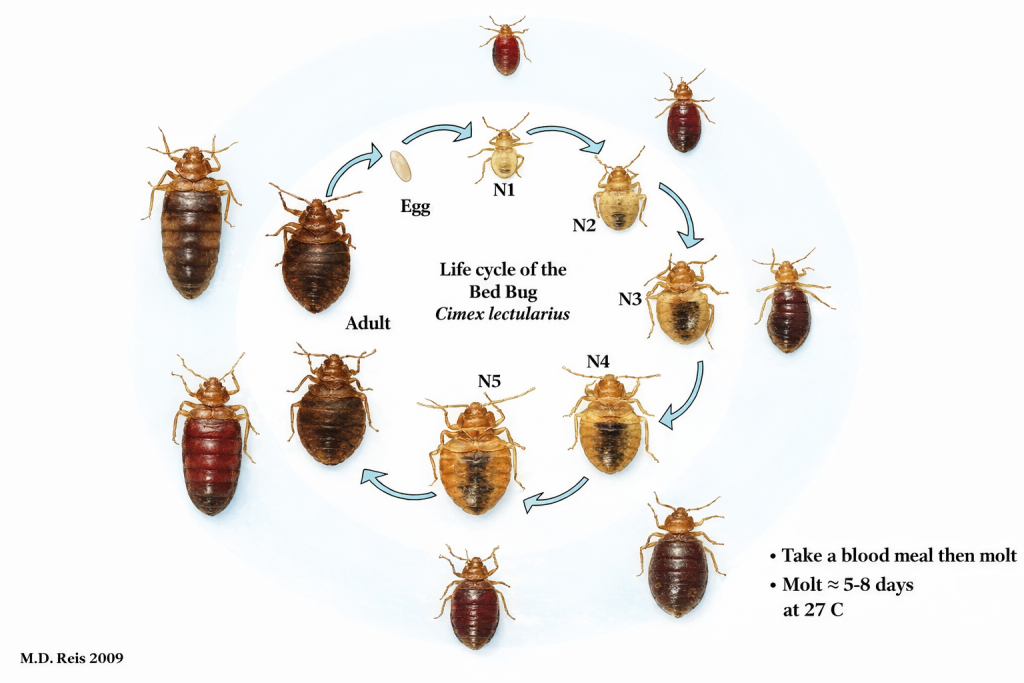
Introduction to the Bed bug Lifecycle The bed bugs that are infesting homes today are the descendents of cave dwelling bugs that originally fed on the blood of bats. When humans began living in the caves, the bugs began feeding on humans. Later, when humans moved out of the caves and started their agricultural civilizations, the bugs moved with them. Since that time, humans have carried bed bugs all over the world. Bed bugs belong to a family of insects called Cimicidae. All members of this family feed exclusively on blood. The common bed bug (Cimex lectularius) has five developmental life stages. Each immature life stage (called nymphs or instars) must take a blood meal in order to develop into the next life stage. Because bed bugs, like all insects, have their skeleton on the outside of their body (exoskeleton) they have to shed their exoskeleton in order to grow larger. This shedding of the exoskeleton is called molting. A bed bug nymph must take a blood meal to molt successfully. After growing through five instar molts, the bed bug becomes an adult. Adult bed bugs, both male and female, must also take regular blood meals to reproduce. The diagram above illustrates the bed bug lifecycle including all instars, before and after feeding. The total development process from and egg to an adult can take place in about 37 days at optimal temperatures (>72° F). Adult bed bugs have a life span of nearly one year depending on regular access to blood meals and favorable temperatures. Feeding Behavior Bed bugs have a cryptic lifestyle, meaning they spend the majority of their time hiding together in cracks and crevices where they will not be seen or disturbed. However, they become active at night, between midnight and 5:00 am. It is during this time, when the human host is typically in their deepest sleep, that bed bugs like to feed. Bed bugs are known to travel many yards to reach their human host. Bed bugs are attracted to CO2 produced by the host exhalations, and they are also attracted to body heat. However, bed bugs are only able to detect these host cues over short distances (about 3 feet away for CO2 and even less for heat). It is not well understood how bed bugs hiding in a closet are able to find a host located in a bed across the room. However, bed bugs are able to move very quickly, and it is thought that they do a lot of wandering around before they are able to locate their food. Ideally, most bed bugs would like to aggregate near the host’s bed, on the mattress or in the boxsprings, when they are not feeding. However, this is not always possible in heavy infestations where bed bugs are crowded and many bed bugs have to seek refuge at distances several yards from the host. Once a bed bug finds the host, they probe the skin with their mouthparts to find a capillary space that allows the blood to flow rapidly into their bodies. A bed bug may probe the skin several times before it starts to feed. This probing will result in the host receiving several bites from the same bug. Once the bed bug settles on a location, it will feed for 5-10 minutes. After the bed bug is full, it will leave the host and return to a crack or crevice, typically where other bed bugs are aggregating. The bed bug will then begin digesting and excreting their meal. Bed bugs usually feed every 3-7 days, which means that the majority of the population is in the digesting state, and not feeding most of the time. Mating Behavior After feeding, adult bed bugs, particularly the males, are very interested in mating. Cimicid bugs have unique method of mating called traumatic insemination. This mating behavior is considered traumatic because the male, instead of inserting his reproductive organ (paramere) into the female genitalia, he literally stabs it through her body wall into a specialized organ on her right side, called the Organ of Berlese. The male sperm is released into the female’s body cavity, where over the next several hours it will migrate to her ovaries and fertilize her eggs. The traumatic insemination stabbing creates a wound in the female’s body that leaves a scar. The female’s body must heal from this wound and consequently, females are known to leave aggregations after being mated several times to avoid any further abuse. Studies have shown that the process of healing from traumatic insemination has a significant impact on the female’s ability to produce eggs. In fact, females that mate only once, and are not subjected to repeated stabbings by the male will produce 25 percent more eggs than females that are mated repeatedly. In practical terms, this means that a single mated female brought into a home can cause an infestation without having a male present, as long as she has access to regular blood meals. The female will eventually run out of sperm, and will have to mate again to fertilize her eggs. However, she can easily mate with her own offspring after they become adults to continue the cycle. Egg Production: The number of egg batches a female will produce in her lifetime is dependent on her access to regular blood meals. The more meals the female can take the greater the number of eggs she will produce. For example, the average adult female will live about one year. If she is able to feed every week, she will produce many more eggs in that year than if she is able to feed only once a month. On average: • A female bed bug will produce between 1- 7 eggs per day for about 10 days after a single blood meal. She will then have to feed again to produce more eggs. • A female can produce between 5 and 20 eggs from a single blood meal.• The number of

Uncategorized

BedBug Characteristics

BedBug Characteristics Bedbugs are small, wingless insects found all over the world. They are nocturnal parasites, which means they rest during the day and are active at night. Bedbugs prefer to hide in bedding and on mattresses where they have ready access to a source of food. Bedbugs have highly developed mouth parts that can pierce skin. Their bite is painless. Some people do not react to the bites, but for others the bites can become itchy and swell into reddened weals. Although bedbugs can harbour diseases in their bodies, transmission to humans is highly unlikely. They are not dangerous, unless a person is allergic to them.  The characteristics of a bedbug include that they: are wingless are half a centimetre long have a flat, oval-shaped body have six legs are light brown in colour, changing to rust-red after a meal of blood have large antennae have large mouth parts have a complex life-cycle involving 5 stages of development have the ability to survive without feeding for months at a time are susceptible to extremes of temperature Bedbugs live exclusively on blood. They prefer human blood, but will feed on other mammals if necessary. Bedbugs are attracted to body heat and the carbon dioxide in expired air, which is how they find their host. Bedbugs commonly target the shoulders and arms. The living areas favored by bedbugs include: mattresses, particularly along the seams bedding such as sheets and blankets beneath loosened edges of wallpaper between the cracks of wooden floors in wall cracks or crevices carpet furniture, particularly in seams and cracks The first indication of a bedbug infestation may be the presence of bites on family members. A thorough inspection of your premises, especially the common hiding spots, may also reveal: the bedbugs themselves – however, due to their size, they are often hard to see small bloodstains from crushed bugs on sheets or mattresses rusty or dark spots of bug excrement on mattresses, bedding or walls an offensive, sweet, musty odour from their scent glands, which may be detected when infestations are severe. Our dogs are trained to detect bed bugs and are far more accurate than human-eye test. They can inspect a room in minutes with visual confirmation from their handler. We are certified through the Wisconsin Pest Control Association and the National Entomology Scent Detection Canine Association. If you think you have bed bugs contact us online or by phone at (608) 882-1508. Not Sure if You Have Bedbugs? Contact Us or Call Today for a Free Consultation Contact Us Call 608-882-1508

Scroll to Top